Practice Records That Help You Pick Up Where You Left Off
Practice records preserve specific details you can revisit, compare, and use, helping you return to a skill without relying on a softened memory.
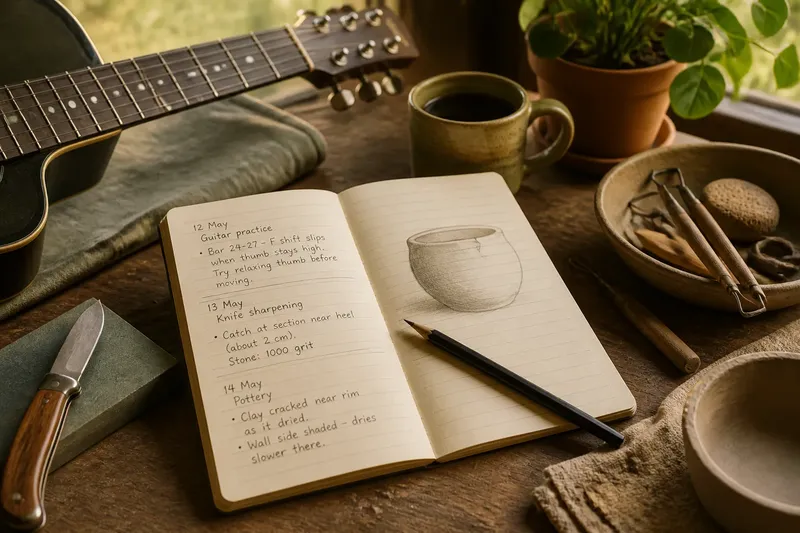
Practice records make it easier to resume a skill by preserving the detail you may forget between sessions. A guitarist can note a troublesome fingering before leaving rehearsal; a gardener can record which seedling appeared beside a shaded wall. The point is not to document every attempt. It is to save something useful to inspect later.
Write down the detail you can check again
After practice, the broad impression often survives—awkward, satisfying, difficult—while the precise snag fades. A note such as “The left-hand shift slips when the thumb stays high” gives the next session a specific observation to check, without turning the page into a verdict on the learner.
A written note works like a paper bookmark: it does not preserve the whole book, only the place worth returning to. Record what happened in plain language, not what you think it says about your ability.
Keep entries short and tied to the activity
A useful entry answers a modest question: what did I notice? Name a passage, tool, material, condition, or change. “The clay cracked near the rim as it dried” leaves a concrete feature to revisit; “Pottery was frustrating” does not.
Say you are learning to sharpen a kitchen knife and notice that the blade catches at one section of the cutting edge. You write down that location and the sharpening stone you used. At the next session, you check whether the same section catches again. If it does, you have a recurring observation to consider; if it does not, you can avoid treating one moment as a settled pattern.
A date can help separate entries, but a timestamp need not take over the page. Add context only when it could help you interpret the observation later, such as the instrument, recipe, tool, location, or material. A record of every surrounding detail can become an archive with one reader and no clear reason to return.
Choose a format that suits the evidence
A bound notebook keeps entries together and is easy to carry. Loose paper suits a one-off drawing, though it can become separated from the notes that explain it. Index cards make observations easy to sort; a digital note can be searched and paired with a photograph or audio clip.
Paper is ready for quick marks without a charged device. Digital notes are easier to search and copy, but can spread across apps and folders. A sketchbook suits spatial observations; text is often clearer for a short verbal cue. Choose the format that fits what you need to remember, not the one that looks most impressive on a desk.
For matters governed by manufacturer instructions or local rules, use those directions as the authority. A notebook can record what you observed, but a personal note is not qualified guidance.
What should practice records include?
What should I write after a practice session?
Write one or two details you may want to inspect again: where a movement felt uneven, which material behaved differently, or what changed after an adjustment. Identify the activity, then leave out the full session narrative.
Should I record successes as well as problems?
Yes, when a success has a feature worth remembering. “The seam stayed flat after I pinned the corner first” preserves a possible clue; “Everything went well” does not say what to look for next time.
How often should I review a notebook?
Review it when an old observation becomes relevant or when you need to recall what you already tried. A brief reread before returning to a project can surface a useful detail without making record-keeping a separate obligation.
Is a phone note as useful as a paper notebook?
It can be, especially when you need to attach a photo, voice memo, or searchable label. Paper may be simpler for a sketch beside a sentence; choose what you can consult where the activity happens.
Make the record easy to return to
A practice record does not need neat handwriting, an elaborate layout, or an entry after every attempt. A margin note can preserve a useful observation, and a later correction can keep it honest.
For practice records to earn their place, keep them close to the activity and write in ordinary language. When you return, compare the note with what is happening now rather than treating the old entry as an instruction. That small distinction lets the record guide attention without pretending to know what the next attempt will bring.