Why Repeating a Skill Is Not the Same as Repeating an Attempt
Purposeful variation in skill practice reveals the choices inside a movement or technique, helping you choose when to repeat, adjust, or change a task.
Skill practice improves when you repeat the important choice, not merely the same sequence of motions. Purposeful variation in skill practice lets you notice how a movement or technique responds to changing conditions, while repeating one attempt can make the conditions so familiar that you stop seeing the decisions involved.
That distinction matters in activities as different as drawing, cooking, tennis, and playing an instrument. Repetition builds familiarity; variation helps you identify what must stay stable and what can change. Neither approach is universally better. The useful choice depends on what you are learning and what is getting in the way.
Repetition can teach a narrow version of a skill
Suppose you practice a guitar chord change by moving between the same two chords at the same pace, in the same passage. Repeating the sequence can make the finger movement smoother. It may also leave you unsure whether you can make the change when the rhythm, chord order, or starting position differs.
A skill is not always a single motion. It often includes decisions about timing, force, direction, sequence, or response to a changing situation. Repeating one attempt gives practice in a particular combination of those choices. That can be useful, but it is narrower than practicing the skill across several combinations.
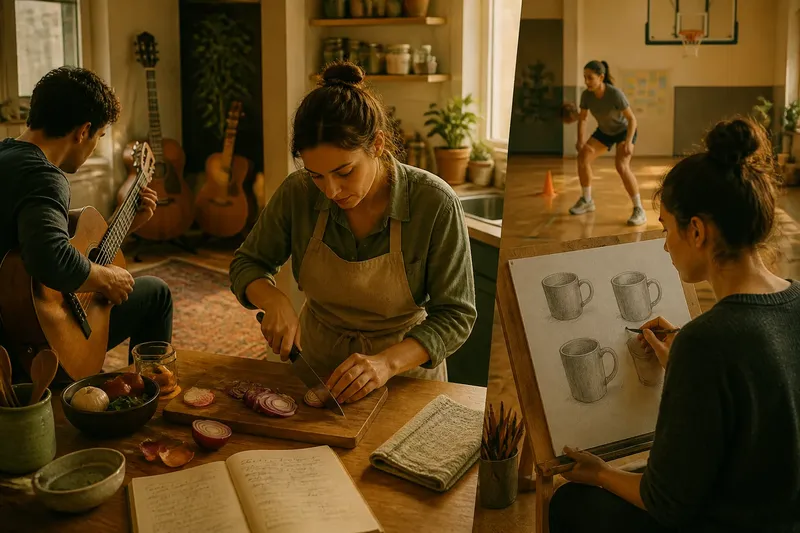
Variation makes those choices visible. A baker adjusting dough by feel, a sketcher drawing the same object from different angles, or a basketball player shooting from different spots encounters a slightly altered problem each time. The activity still belongs to the same skill, but it no longer offers an identical script.
Think of a kitchen drawer: repeating one attempt is like learning to open it from one exact position; varying practice is like learning where the handle is from several angles. The drawer is still the drawer. You are learning which part of the action is dependable and which part needs adapting.
Three practice approaches serve different purposes
Repeat one version when the basic action is unclear
Focused repetition is useful when you are still working out the basic shape of an action. A beginner learning a pottery wheel’s steady hand position, for instance, may benefit from keeping the clay, tool, and goal consistent long enough to notice what the hands are doing.
This approach suits tasks with an unfamiliar physical pattern or a sequence that falls apart before you can identify the cause. Keep the practice narrow, but pay attention to one feature at a time: pressure, timing, alignment, or the order of movements. If you change several conditions at once, it becomes harder to tell what produced the difference.
Move on when you can describe the action and make it with reasonable control, not only when it feels automatic. The point is to establish a workable starting version. Staying with it indefinitely can turn a helpful exercise into a routine that teaches little beyond that exact setup.
Vary one condition when you need to understand the choices
Changing one condition at a time is useful when you can perform the basic action but do not yet know how it responds to different demands. A pianist might keep the passage and fingering but change the tempo. A cook might prepare the same vegetable with different cuts while keeping the cooking method steady.
This approach suits skills where the learner must make adjustments rather than reproduce a fixed sequence. A tennis player might practice the same groundstroke while changing the incoming ball’s direction. A drawing student might sketch a mug from different angles, noticing how the rim and handle shift in view.
Keep the variation small enough that the task remains recognizable. If the material, pace, goal, and surroundings all change together, the result may be difficult to interpret. The learner needs enough consistency to compare attempts, and enough difference to notice what the skill requires.
Mix several versions when the skill must adapt in real time
Once you understand the basic action and have explored a few variations, mixing them can help you practice choosing what to do without a fixed cue. A recreational soccer player might alternate passes to different targets instead of taking a long run of identical passes to one spot.
This approach suits activities where the next action depends on what happens next: conversation, improvisation, field sports, or responding to a customer’s question. It can feel less smooth than repeating one version because each attempt asks for a fresh decision. That friction is part of the task, not necessarily evidence that practice has gone wrong.
Mixed practice is less useful if you are still trying to discover the basic motion. If each attempt feels unfamiliar in every respect, return to a narrower version, identify one manageable adjustment, and build from there. Practice should expose choices, not bury them under novelty.
Choose a variation that answers a real question
Before changing a task, name the uncertainty you want practice to address. “Can I keep the line steady when I draw faster?” is more useful than “How can I make this harder?” The first question points to a condition you can alter and an observable feature you can watch.
Imagine you are learning to chop onions evenly. You can make a familiar cut repeatedly, but the pieces keep coming out irregular. Say you decide to keep the knife, board, and onion type the same and vary only the size of the pieces you aim for, from broad slices to smaller dice. You can then observe whether your hand position and pacing remain controlled as the target changes. The aim is not to manufacture difficulty; it is to find which part of the action needs attention.
Useful variations usually come from the demands of the activity itself:
- Change the pace. Slow a passage, then return to its usual tempo, or practice a craft movement at a more deliberate speed.
- Change the starting point. Begin a drawing from a different feature, or start a familiar movement from another position.
- Change the target. Aim a pass at a different teammate or draw the same object at another scale.
- Change the material or tool. Try a different paper texture or kitchen utensil when adapting to materials is part of the skill.
- Change the order. Shuffle a set of musical patterns, recipe tasks, or practice prompts instead of following the same sequence.
These are options, not a prescription to change everything. Pick a condition that connects to the real task, keep the other conditions steady where possible, and watch one feature of your performance. If you cannot tell what the variation is meant to teach, it is probably just a new task.
Use feedback to decide whether to repeat or adjust
Feedback does not have to come from a coach or a recording. It can be a visible result, a sound, the feel of a tool, or the response of another person. The useful question is whether that information helps you make a better decision on the next attempt.
For a drawing exercise, you might compare the angle of a line with the reference. For a recipe, you might notice whether the cut pieces cook at a similar pace. For a spoken presentation, you might listen for whether a key point remains clear when you change the order of the material. Choose feedback tied to the goal; collecting details without a decision attached is a hobby of its own.
Repeat the same version when feedback points to a basic element that is not yet clear. Adjust one condition when you can perform the action but need to understand its limits. Mix versions when you can make the relevant adjustment and want to practice choosing it without a predictable cue.
It also helps to distinguish a poor result from a useful signal. If a changed tempo makes a passage uneven, that tells you something about control at that pace. It does not, by itself, tell you to abandon the variation or change every part of the exercise.
Purposeful variation in skill practice works best with a clear boundary
Variation should stay inside the skill you intend to build. If you are learning to knead bread dough, changing the dough, recipe, surface, and technique all at once may turn practice into a different problem. Choose a boundary: perhaps keep the recipe stable while paying attention to how pressure changes the dough’s shape and resistance.
Where a task involves equipment, food handling, or physical risk, follow the relevant label, manufacturer instructions, or local rules. For safety-critical activities, rely on qualified instruction rather than improvising practice conditions.
A simple decision rule is to ask what you need next: familiarity, comparison, or adaptation. Choose repetition for familiarity, one controlled variation for comparison, and mixed versions for adaptation. If you are unsure, start with one change and see whether it makes the skill’s choices easier to notice.
The goal is not to make every attempt different. It is to make each attempt answer a useful question. That is the difference between repeating a skill and replaying an attempt: one builds options you can recognize, while the other may only polish a route you already know.